Civic Tech Field Guide
Sharing knowledge and productively growing the fieldThe Tech > Emerging tech > Artificial Intelligence > Governance of AI - (55)
Projects that seek to improve and democratize societal governance over AI technologies in order to protect people and democratic values.
Showing 55 Results

Canada's cities and smaller communities are facing a looming crisis in deferred maintenance and construction of critical infrastructure, both physical and social.

Democratic Digital Commons - European Alternatives
European Union (EU)Together, we will run a series of assemblies across Europe to understand our current digital infrastructure & governance, and reimagine, showcase & demand a Democratic Digital Commons.
In this paper, we set out a vision for a different path for AI.
City AI-Policy Toolkit
United States of America 🇺🇸A public toolkit of templates, prompts, workflows, examples, and evaluation checks for municipal AI governance.

Auditing AI
Massachusetts Institute of Technology (MIT)How tech companies, journalists, and policymakers can prevent AI decision-making from going wrong.
LawZero
Montreal, QC, CanadaLawZero is a nonprofit startup developing technical solutions for highly-capable, safe-by-design AI systems.
ANTIPARTY AI Webinar Series
United Kingdom of Great Britain and Northern Ireland 🇬🇧In our democracy, how can AI enhance our engagement in society, keep the government in check and improve the function of democratic processes?

REAL ML
OregonREAL ML supports and advances interdisciplinary research that holds the use of algorithms and AI technologies to account—with a focus on the perspectives and experiences of marginalized communities

An open-source project released under the Microsoft organization and MIT license that brings runtime security governance to autonomous AI agents.

gov/acc is a research program focused on accelerating governance innovation and experimentation in web3 communities.

Governable Space-Makers Fellowship
United States of America 🇺🇸The fellowship invited a team of three fellows to combine artistic, technical, and ethnographic methods to produce an interactive online space for exploring a particular aspect of self-governance, as well as a speculative ethnography detailing their the team's working process and the implications of their work in the context of an evolving landscape of where and how governance happens online.
ADL AI Index
New York City (NYC / New York, NY)The ADL AI Index evaluates leading large language models (LLMs) on their ability to detect and counter antisemitic and extremist tropes and narratives.
Responsible AI Safety and Education Act (RAISE Act)
New York stateNY State Assembly Bill 2025-A6453A has become law,
Introduction to AI assurance (GOV.UK)
United Kingdom of Great Britain and Northern Ireland 🇬🇧AI assurance can help to provide the basis for consumers to trust the products they buy will work as intended; for industry to confidently invest in new products and services; and for regulators to monitor compliance while enabling industry to innovate at pace and manage risk.
Portfolio of AI assurance techniques (GOV.UK)
United Kingdom of Great Britain and Northern Ireland 🇬🇧This page provides details about DSIT's portfolio of AI assurance techniques and how to use it.
AI in the Street
United Kingdom of Great Britain and Northern Ireland 🇬🇧To make AI visible for everyday publics, researchers worked together with artists, designers and local partners to create street-based interventions in 5 cities in the UK and Australia, aiming to ground understandings of AI in lived experiences.
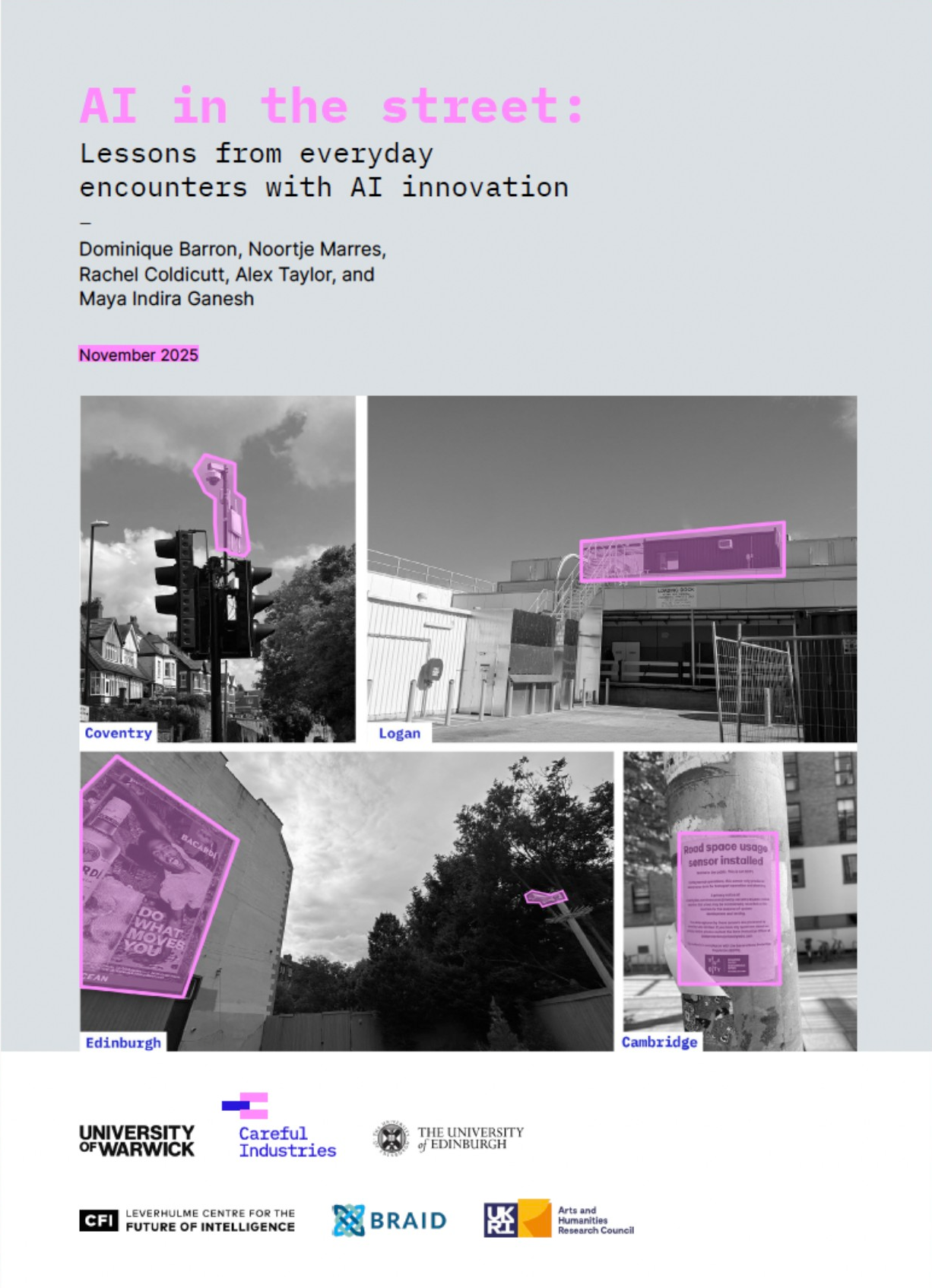
AI in the Street report
United Kingdom of Great Britain and Northern Ireland 🇬🇧One year on from AI in the Street project, this new report discusses what we learnt about how local communities and everyday publics make sense of data-intensive and AI-based technologies in their everyday environments.
In this note we offer AI companies, specifically those that train and deploy frontier models, a set of viable and achievable options for democratizing the governance structures of their organizations.
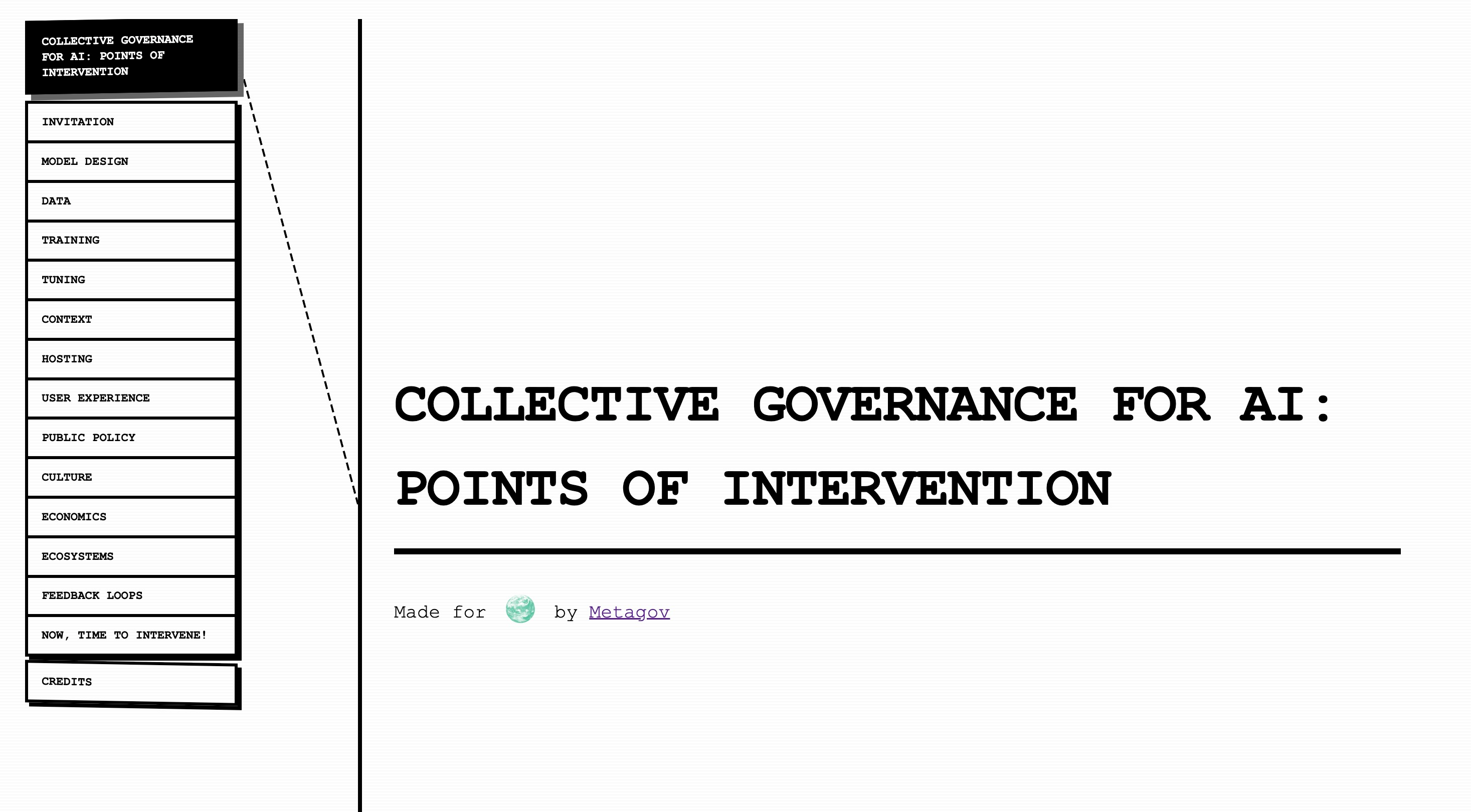
Collective Governance for AI: Points of Intervention
United States of America 🇺🇸Metagov breaks up the thorny problem of AI governance into smaller, easier problems and intervention points
Coefficient Giving
San FranciscoWe’re a philanthropic funder that partners with leading donors to multiply their impact.

Civilization V video game mod: Superintelligent AI
Cambridge, UKResearchers from the University of Cambridge's Centre for the Study of Existential Risk (CSER) have released a mod for Civilization V that introduces superintelligent AI into the popular video game.

Up-to-date developments and analyses of the EU AI Act and its implementation

We urgently call for international red lines to prevent unacceptable AI risks. Launched during the 80th session of the United Nations General Assembly, this call has broad support from prominent leaders in policy, academia, and industry.

EyesOnOpenAI
CaliforniaA coalition calling for transparency on OpenAI's efforts to transition from public benefit nonprofit to for-profit

OECD.AI is an online interactive platform dedicated to promoting trustworthy, human-centric artificial intelligence (AI).
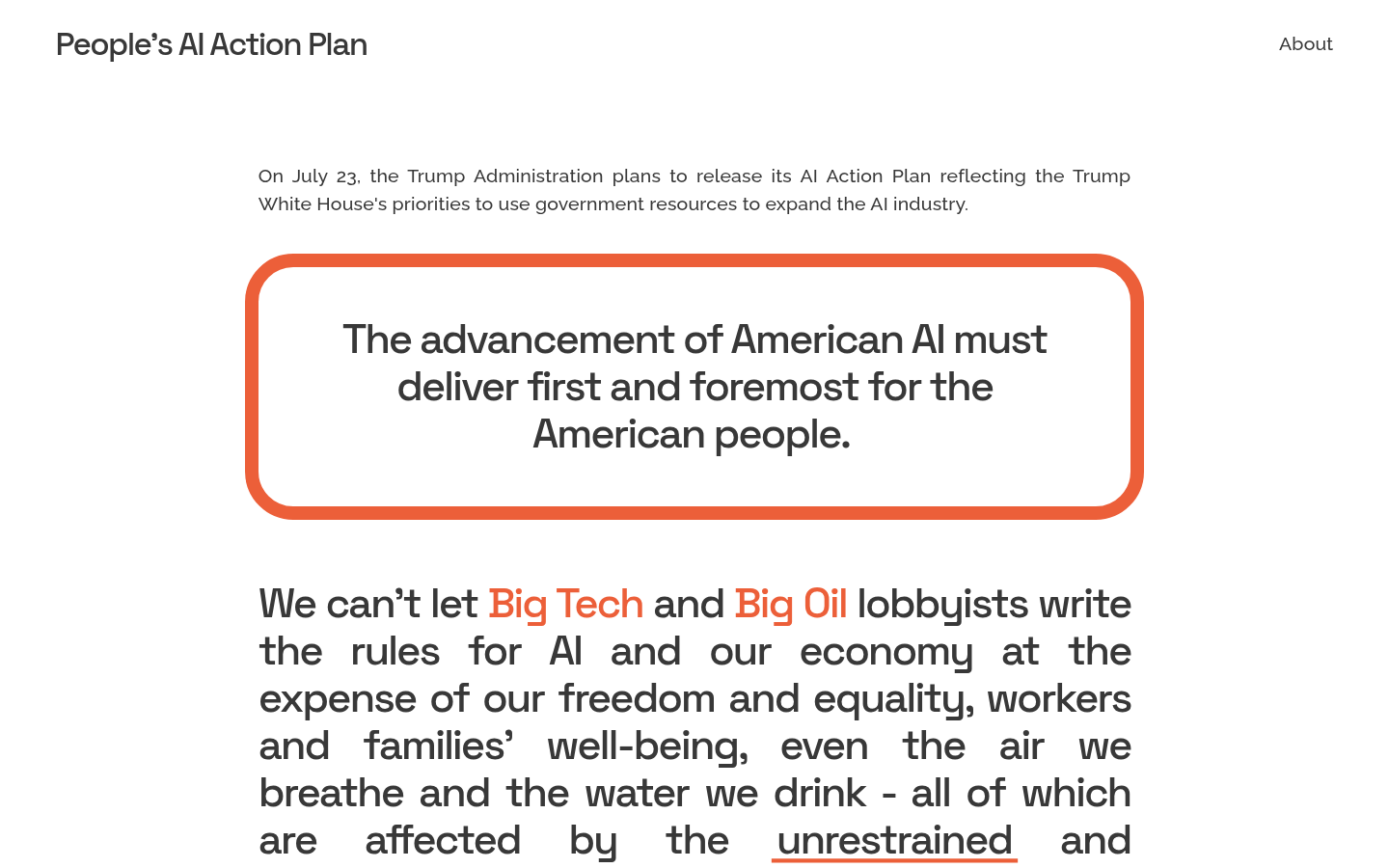
People's AI Action Plan
New York City (NYC / New York, NY)A broad coalition of 130+ tech, economic justice, consumer protection, labor, environmental justice, and civil society organizations launched the People’s AI Action Plan to provide a direct counter-weight to President Trump’s industry-backed AI executive orders and agenda.

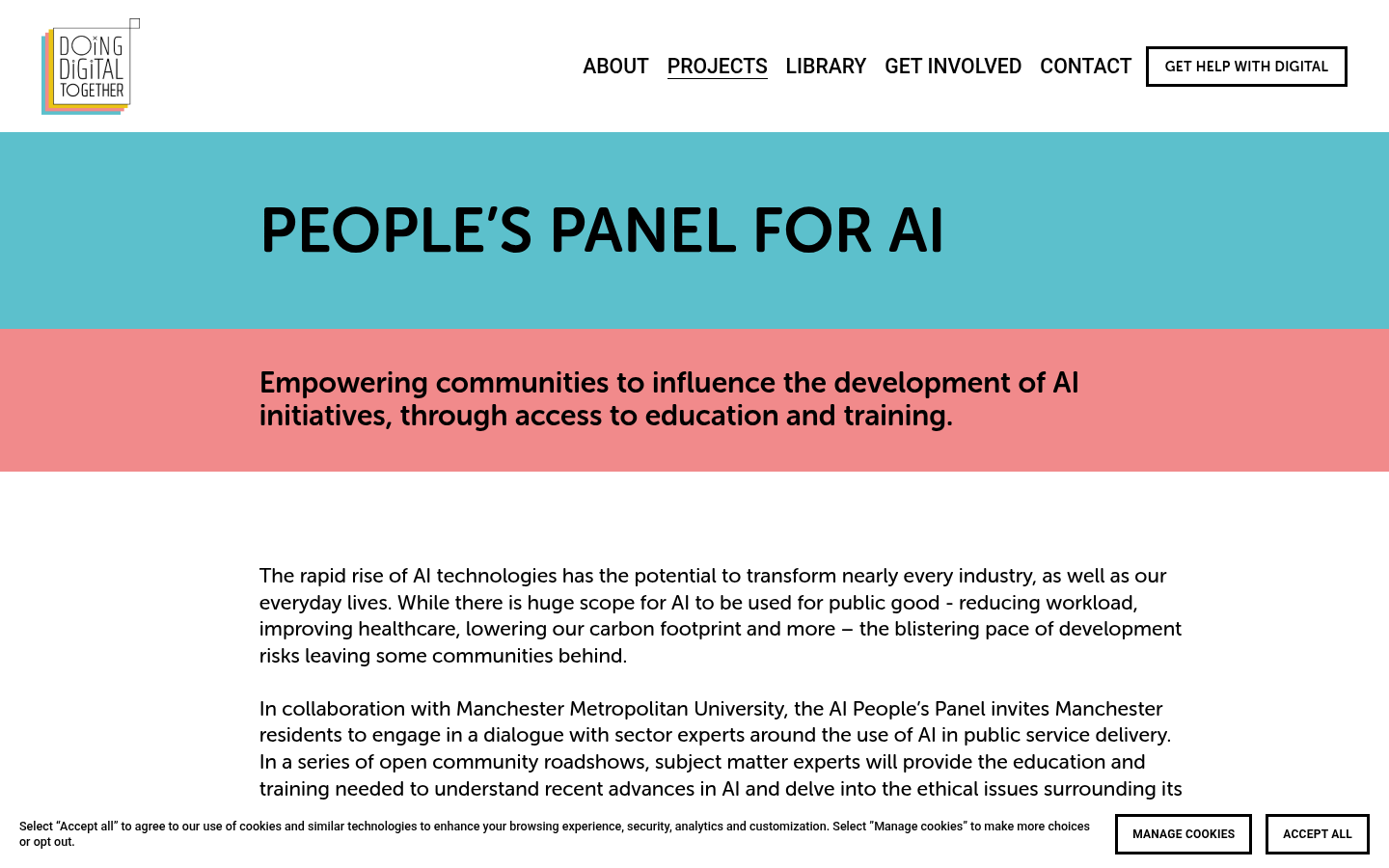
People's Panel for AI (Manchester)
Manchester, United KingdomEmpowering communities to influence the development of AI initiatives, through access to education and training.

AI Safety Asia (AISA)
ManilaAI Safety Asia (AISA) is a global non-profit dedicated to the international governance of safe AI by Asia, starting in Southeast Asia.

AISA Governance Academy
ManilaA 12-week fellowship in AI Safety and Governance for junior researchers and government staff in Southeast Asia
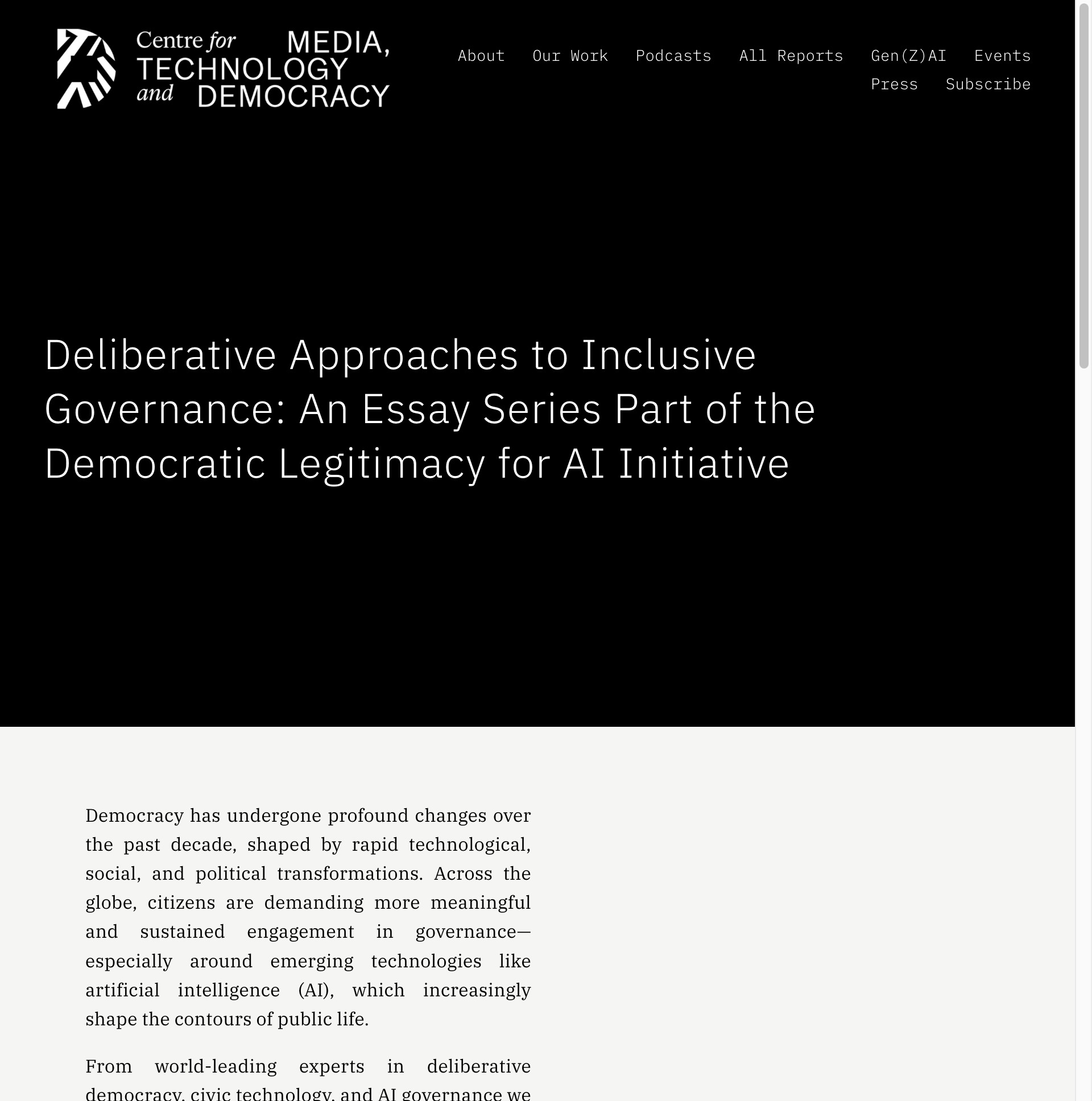
Deliberative Approaches to Inclusive Governance
Montreal, QC, CanadaFrom world-leading experts in deliberative democracy, civic technology, and AI governance we introduce a seven-part essay series exploring how deliberative democratic processes like citizen’s assemblies and civic tech can strengthen AI governance.

AI Policy Bulletin publishes policy-relevant perspectives on frontier AI governance.

Indigenous AI
GlobalThe Indigenous Protocol and Artificial Intelligence (A.I.) Working Group develops new conceptual and practical approaches to building the next generation of A.I. systems.

The first edition of PAIRS took place as an independent side-event of the Paris AI Action Summit (10th - 11th Feb 2025) providing a space to present research and case studies on the state of the art in participatory development and governance of AI, and to build stronger connections across the field.

Governance of Emerging Technology and Tech Innovations for Next-Gen Governance (GETTING-Plurality)
Harvard Kennedy School, John F. Kennedy Street, Cambridge, MAA multi-disciplinary research network linking philosophers, social scientists, computer scientists, legal scholars, and technologists.

OpenAI is funding research at Duke University to develop algorithms that can predict human moral judgments in scenarios involving conflicts among morally relevant features in medicine, law, and business

Open and accessible tools that put safety back in the hands of the people

How can we ensure more inclusive and responsible AI so that diverse harms can be foreseen and mitigated, and its benefits equitably enjoyed around the world?

In this paper, building on insights from the theory and practice of deliberative democracy, we provide a "Democracy Levels" framework for evaluating the degree to which decisions in a given domain are made democratically.

Facebook Community Forums on AI
Facebook, Hacker Way, Menlo Park, CAWe partnered with Stanford’s Deliberative Democracy Lab and the Behavioral Insights Team on a Community Forum to discuss the principles that can be reflected in generative AI chatbots – and today, we’re releasing the results.

Connected by Data
Epsom, UKWe campaign for communities to have a powerful say in decisions about data and AI

Clever Together
LondonWe help forward-thinking leaders to embed evidence, expertise, and lived experiences into the heart of decision-making.

The AI Governance Fellowship is a pioneering program dedicated to advancing the fairness and integrity of AI technologies in the Global South, with a focus on African nations.

A grassroots interdisciplinary responsible AI lab for Africa and the Global South. Researching technical alignment and governance of AI.
ForHumanity
New York stateTo examine and analyze the downside risks associated with the ubiquitous advance of AI & Automation, to engage in risk mitigation and ensure the optimal outcome… ForHumanity.

AI & Democracy Foundation
San FranciscoTo accelerate work toward democratic governance and alignment of AI.

S.4495 - A bill to enable safe, responsible, and agile procurement, development, and use of artificial intelligence by the Federal Government, and for other purposes.

Enrolling Citizens: a primer on archetypes of democratic engagement with AI
Data & Society Research Institute, West 20th Street, New York, NYPrimer by Wanheng Hu and Ranjit Singh

Meta's Community Forum on Generative AI
Facebook, Hacker Way, Menlo Park, CAMeta's "Community Forums bring people together to discuss tough issues, consider hard choices and share recommendations for improving people’s experiences across our apps" using Stanford's deliberative polling method

The Public AI Network is a coalition working to bring about public AI.
Get email updates
Helpful Links
Reach Out
A project of

With support from
National Endowment for Democracy
Founding Organization
Civic Hall
Technology partner

 Civic Tech Field Guide