Civic Tech Field Guide
Sharing knowledge and productively growing the field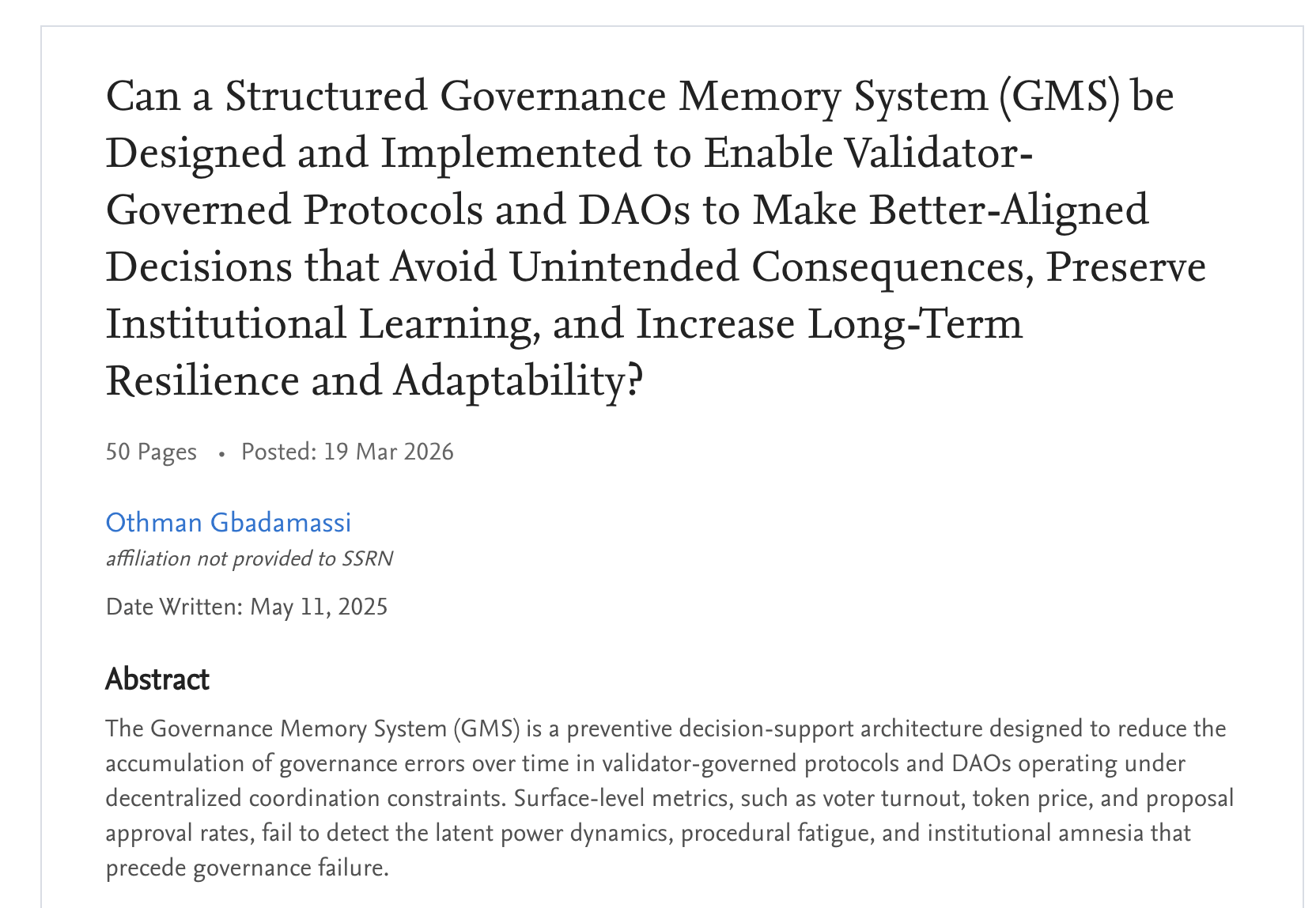
Can a Structured Governance Memory System (GMS) be Designed and Implemented to Enable Validator-Governed Protocols and DAOs to Make Better-Aligned Decisions that Avoid Unintended Consequences, Preserve Institutional Learning, and Increase Long-Term Resilience and Adaptability?
The Governance Memory System (GMS) is a preventive decision-support architecture designed to reduce the accumulation of governance errors over time in validator-governed protocols and DAOs operating under decentralized coordination constraints. Surface-level metrics, such as voter turnout, token price, and proposal approval rates, fail to detect the latent power dynamics, procedural fatigue, and institutional amnesia that precede governance failure.
Drawing on practitioner interviews and case studies from NEAR, Gitcoin, and Juno, this paper introduces a five-layer framework (Proposal Lifecycle Metadata, Outcome Review Anchors, Informal Power Mapping, Governance Health Index, Recurring Themes & Frictions) that tracks proposal lifecycles, anchors outcome reviews, maps informal power, and synthesizes feedback across governance cycles. Rather than treating governance as an episodic voting activity, GMS frames governance health as an adaptive process shaped by attention constraints, incentive alignment, and evolving mission objectives. Robust governance depends on a system's capacity to withstand stress, align outcomes with stated goals, and avoid collateral damage. It cannot solely rely on activity metrics. In decentralized environments where formal authority is limited and legitimacy must be continuously renewed, structured memory and adaptive feedback become infrastructural rather than optional.
| Organization Type: | Academic / research organization |
|---|---|
| Status: | Active |
| Last Modified: | 5/2/2026 |
| Added on: | 4/2/2026 |
Project Categories
Get email updates
Helpful Links
Reach Out
A project of

With support from
National Endowment for Democracy
Founding Organization
Civic Hall
Technology partner

 Civic Tech Field Guide