Civic Tech Field Guide
Sharing knowledge and productively growing the field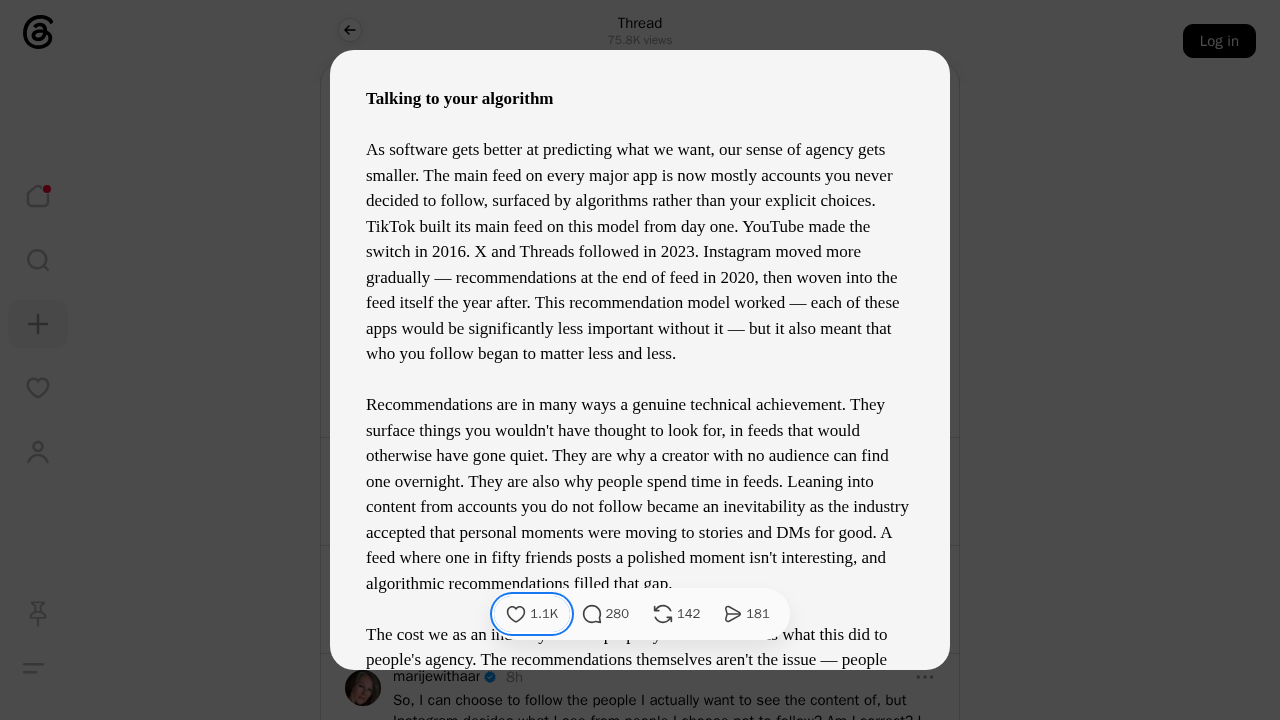
A feature on Threads that gives users control over their algorithmic feed.
As software gets better at predicting what we want, our sense of agency gets smaller. The main feed on every major app is now mostly accounts you never decided to follow, surfaced by algorithms rather than your explicit choices. TikTok built its main feed on this model from day one. YouTube made the switch in 2016. X and Threads followed in 2023. Instagram moved more gradually — recommendations at the end of feed in 2020, then woven into the feed itself the year after. This recommendation model worked — each of these apps would be significantly less important without it — but it also meant that who you follow began to matter less and less.
Recommendations are in many ways a genuine technical achievement. They surface things you wouldn't have thought to look for, in feeds that would otherwise have gone quiet. They are why a creator with no audience can find one overnight. They are also why people spend time in feeds. Leaning into content from accounts you do not follow became an inevitability as the industry accepted that personal moments were moving to stories and DMs for good. A feed where one in fifty friends posts a polished moment isn't interesting, and algorithmic recommendations filled that gap.
The cost we as an industry haven't properly reckoned with is what this did to people's agency. The recommendations themselves aren't the issue — people clearly find them valuable, and on Instagram alone they're shared in DMs billions of times a day. But who you follow used to be a meaningful tool people had for shaping their own experience, and as recommendations took over the main feed that tool quietly stopped working. The conversation with the system became one-sided. The system learns from what you tap, watch, and share, but you don't really get to tell it what you want. I think this is part of what people feel when they feel uneasy about social media — not the content itself, but the sense that the experience is happening to them rather than being shaped by them.
The reason this is worth raising now is that something is shifting in what's technically possible. For years ranking models have been built with technologies that aren't legible to people — no human can read a neural net and explain why an algorithm thought you might be interested in a given video. You can't have agency over a system that lacks an interface you understand. Ranking systems have long represented content as embeddings — coordinates in a kind of map where similar things sit close to one another. A photo of one of Colman Domingo's outfits is close to a video from Micah McDonald, his stylist, about menswear, which is close to the topic "men's fashion." But the system could only see those coordinates as numbers. What's new is that LLMs can now look at clusters of content and describe them in language people understand. That gives us a way to show people what the system thinks they're interested in, and a way for them to tell the system what they actually want.
At Instagram, we've started with something we call Your Algorithm. I've been looking at mine all week. It surfaces the topics the system thinks you're most interested in — you can see them, add ones you want more of, and remove ones you don't. Your Algorithm is live across Reels, Explore, and as of this week, Feed. Topics are only the start; we're actively working on supporting requests for people, different moods or vibes, content types, and more.
This is the start of something bigger than a feature. I believe it's in our best interest as a business to empower people to shape Instagram into something that works for them, and that people should be able to have a meaningful amount of agency over the products they spend so much time in. We intend to build much of what comes next on that principle.
There's a harder version of this question on the horizon that's worth saying out loud. Within a few years, AI will be capable of not only letting us see and shape algorithms, but also generating entire bespoke experiences on the fly, tailored to an individual in real time. At that point you can imagine shaping much more than how ranking works in an app like Instagram — the structure of the app itself, the experiences inside it, even the things the app is for could be different for each of us.
A world where you are making personalized experiences on the fly is exciting in terms of agency, but at the extreme starts to undermine shared experiences; if AI can generate entire apps and experiences that each of us wants, you and I might no longer share any sense of space. The version of agency we're starting to ship now — where you shape what you see — is unambiguously good and overdue. The version that's coming is more complicated. I'm optimistic, though, because people genuinely want shared experience — and underneath that, connection to each other. We have access to nearly infinite music, and a lot of us still listen to the same songs. The pull toward shared experience is durable because what we're really after isn't the content, it's the people we share it with — and that's worth designing toward as agency over our experiences keeps expanding.
| Organization Type: | For-profit business / social enterprise / B Corp |
|---|---|
| Status: | Active |
| Founded: | 2026 |
| Parent Organization: | |
| Last Modified: | 6/11/2026 |
| Added on: | 6/11/2026 |
Project Categories
Get email updates
Helpful Links
Reach Out
A project of

With support from
National Endowment for Democracy
Founding Organization
Civic Hall
Technology partner

 Civic Tech Field Guide